
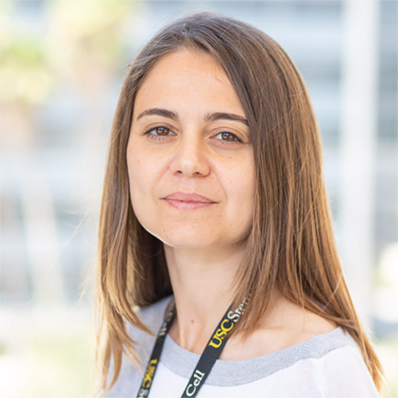
Quadrato, Giorgia
Associate Professor of Stem Cell Biology and Regenerative Medicine
The Quadrato lab focuses on understanding the cellular and molecular basis of human brain development and mental disorders. We seek to produce meaningful work that advances the fundamental knowledge of our field and provides new tools to do it. By combining emerging models of the human brain with single-cell -omics approaches, we aim to identify brain region and cell type-specific disease mechanisms and, above all, new treatments for neuropsychiatric disorders. To improve the physiological relevance of human pluripotent stem cell-derived organoids, our lab is leveraging interdisciplinary strategies and technologies aimed at tighter regulatory control of organoid development through bioengineering approaches, along with newer unbiased organoid analysis readouts.


Sieburth, Derek
Associate Professor of Physiology & Neuroscience
Our lab is interested in understanding how neuronal signal transduction pathways regulate neurotransmitter secretion and how this impacts the function of underlying neuronal circuits that control behavioral output.

Tao, Huizhong W.
Professor of Physiology and Neuroscience
My lab studies how the mouse brain processes visual information and transforms it into behavior. Our research focuses on identifying the neural circuits involved in visual perception and how these circuits drive visually guided actions. We use a combination of techniques—including electrophysiology to record neural activity, microendoscopic calcium imaging to monitor populations of neurons in freely moving animals, and both optogenetics and chemogenetics to precisely manipulate specific circuit components. By integrating these approaches, we aim to understand how visual signals are encoded, transmitted, and used to guide behavior at the level of individual neurons and larger networks.

Zhang, Li
Professor of Physiology and Neuroscience
As systems neuroscientists, we aim to decipher brain circuits to understand how perception and behavior arise, how the brain adapts to a dynamic environment, and how circuit dysfunction contributes to neurological and psychiatric disorders. We focus on resolving neural architecture—the wiring of neurons that underlies brain function. Technical innovation is central to our approach. We have developed molecular, genetic, electrophysiological, and imaging tools to study circuits supporting both local computation and behavior. Our research integrates in vivo and in vitro electrophysiology, two-photon calcium imaging, neural modeling, anatomical tracing, and optogenetics to build a comprehensive understanding of cell-type-specific circuit mechanisms.